
(And What Most Small Businesses Get Wrong)
If you’re a small business owner, chances are you’ve been hit with an overwhelming amount of marketing advice lately.
“You need to be on Facebook.”
“SEO is the only thing that matters.”
“TikTok is where your customers are.”
“Email marketing is dead. Actually, it’s back.”
The tactics never stop coming. And neither does the overwhelm.
I see it every day working with local businesses across Western Canada. Business owners trying to do everything, spreading themselves thin across a dozen different platforms, and wondering why nothing seems to work.
Here’s the truth most marketing “experts” won’t tell you:
Most marketing fails because there’s no foundation.
Lessons from the Farm: Marketing Takes Patience
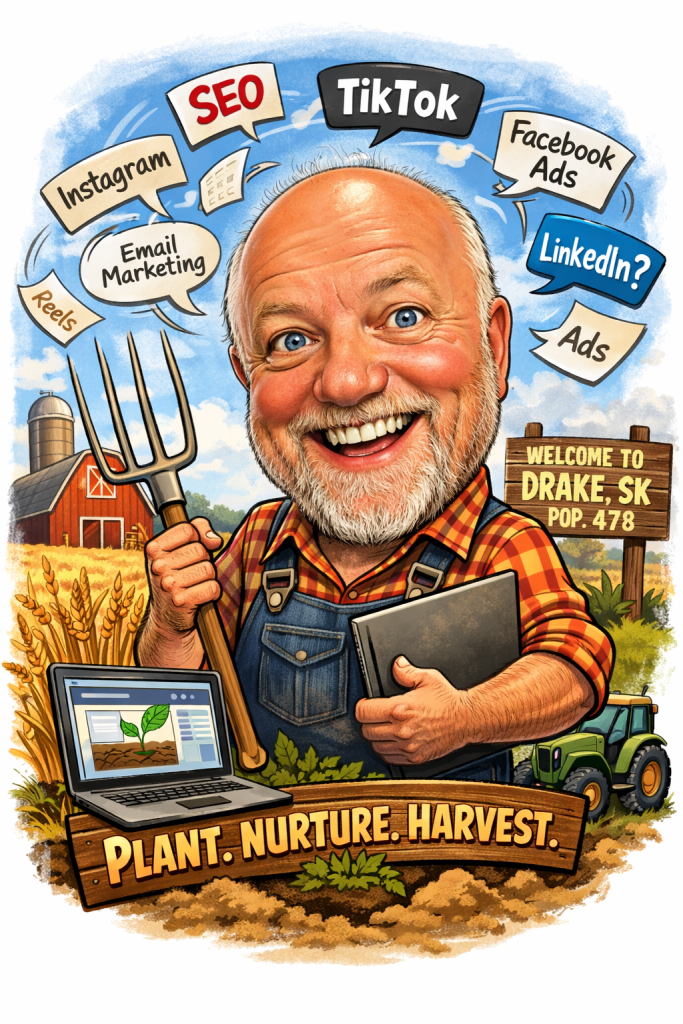
I grew up on a farm 6 miles down a grid road from Drake, Saskatchewan. Population never quite hit 500, no matter how hard we tried. (Those hockey players we brought in for the winter only got us to 478… we were close though.)
On the farm, you learn patience. You learn that things take time.
You don’t plant wheat on Monday and expect bread on Tuesday.
You prepare the soil. You plant what makes sense for your land and your climate. You tend it through the season. And then, when the time is right, you harvest.
Your business marketing works exactly the same way.
Your website is the field. Everything else—your social media, your ads, your networking, your email campaigns—those are the seeds you plant that should point back to that field.
But if your website isn’t set up as your true business hub… if it’s just sitting there like a digital brochure collecting dust… then all those other tactics are just expensive noise.
What Does “Business Hub” Actually Mean?
Let me break this down in plain language, because too many consultants make this more complicated than it needs to be.
When your website is your business hub, it means:
It’s where people learn about you. Not just what you do, but who you are, what you stand for, and why they should trust you. Your website tells your story in a way that a Facebook post or Instagram bio never can.
It builds trust while you sleep. A well-designed website with clear information, customer testimonials, and helpful content works 24/7. It’s answering questions and building credibility even when you’re not around.
It captures leads when you’re not available. Whether it’s a contact form, a newsletter signup, or a booking system, your website should be capturing potential customers even when you’re busy serving existing ones.
It ties everything together. Your social media posts? They drive traffic to your website. Your email campaigns? They link back to your website. Your Google My Business listing? It sends people to your website. Everything converges at your hub.
It works like good farm equipment. Once it’s set up right, it pays for itself over and over. It’s an asset that generates value consistently, not an expense you keep throwing money at.
Why Most Small Business Websites Fail
Here’s where most businesses go wrong:
They treat their website like a business card instead of a business hub.
They put up a few pages with basic information, maybe some stock photos, and then… nothing. It just sits there.
No clear call to action. No way to capture leads. No fresh content. No reason for people to come back.
Then they wonder why their website “doesn’t work.”
It’s like buying a tractor and leaving it in the shed. Of course it doesn’t work—you’re not using it.
Or they chase every shiny tactic without building the foundation first.
They jump on the latest social media platform. They try running ads without knowing where to send the traffic. They post content without a strategy.
It’s like planting seeds in rocky soil and wondering why nothing grows.
Small-Town Values Meet Digital Strategy
Here’s what I learned growing up in a small town that applies directly to your marketing:
Patience pays off. We didn’t rush things on the farm. We knew that good things take time. Same with your marketing. You’re not going to go viral overnight, and that’s okay. Steady, consistent effort wins.
Help your neighbors. In a small town, you help people because it’s the right thing to do. In marketing, that means providing real value before you ask for the sale. Share helpful information. Answer questions. Be genuinely useful.
Do things right, not just fast. We fixed things properly on the farm, even if it took longer. Cutting corners always came back to bite us. Same with your website and marketing. Do it right the first time.
Build real relationships. In Drake, everyone knew everyone. You couldn’t fake it. Your reputation mattered. Online, it’s the same. Authenticity wins. People can smell BS a mile away.
The Three Pillars of a Website That Actually Works
If you want your website to be a true business hub, focus on these three areas:
1. Know Your Audience (Like You Know Your Neighbors)
You wouldn’t try to sell snow tires to someone in Florida. Yet businesses do the equivalent online all the time.
Who are you actually serving? What keeps them up at night? What problems are they trying to solve?
Your website should speak directly to those people, in language they understand, addressing the specific challenges they face.
2. Craft Your Message (Speak Their Language, Not Jargon)
Nobody cares about your “synergistic solutions” or “best-in-class offerings.”
They care about whether you can solve their problem.
Your website copy should be clear, simple, and focused on the customer’s needs—not your features.
Tell them what you do, how it helps them, and what they should do next. That’s it.
3. Optimize for Results (Make It Easy to Say Yes)
Your website should make it ridiculously easy for people to take the next step.
Clear calls to action on every page. Simple contact forms that actually work. Fast loading times (nobody waits for slow websites anymore). Mobile-friendly design (most people are on their phones). Trust signals like testimonials and reviews.
If someone has to hunt for your phone number or figure out how to contact you, you’ve already lost them.
The Work Hard, Play Hard Approach to Marketing
Here’s the thing about getting your marketing foundation right:
When your website is working as your true business hub, you can actually focus on what you do best—serving your customers and running your business.
You’re not constantly scrambling to post on social media or chase the latest marketing trend.
Your website is working for you 24/7. Your systems are capturing leads. Your content is building trust.
You work hard to set it up right. Then you can play hard, knowing your marketing is handling itself.
That’s the goal.
Let’s Make It Easy
I’ve been helping local businesses across Western Canada with their digital marketing for over 20 years. Before that, I spent a lifetime on the farm learning patience, hard work, and the value of doing things right.
Here’s what I know for sure:
Your marketing doesn’t have to be complicated. It doesn’t have to be overwhelming. And it definitely doesn’t have to drain your bank account without results.
It just needs a solid foundation.
What’s your biggest marketing frustration right now?
Is it the overwhelm of too many tactics? The feeling like you’re throwing money at things and not seeing results? Not knowing where to start?
Let’s talk about it. Drop a comment below or reach out directly.
I’m here to help cut through the noise and make marketing easy for you.
Because at the end of the day, your business deserves a marketing strategy that works as hard as you do.
Let’s make it easy.
